Multi-story vertical construction demands rigorous adherence to sanitation logistics to prevent costly worker transit delays. In the Channel District and downtown corridors near Amalie Arena, moving laborers down…
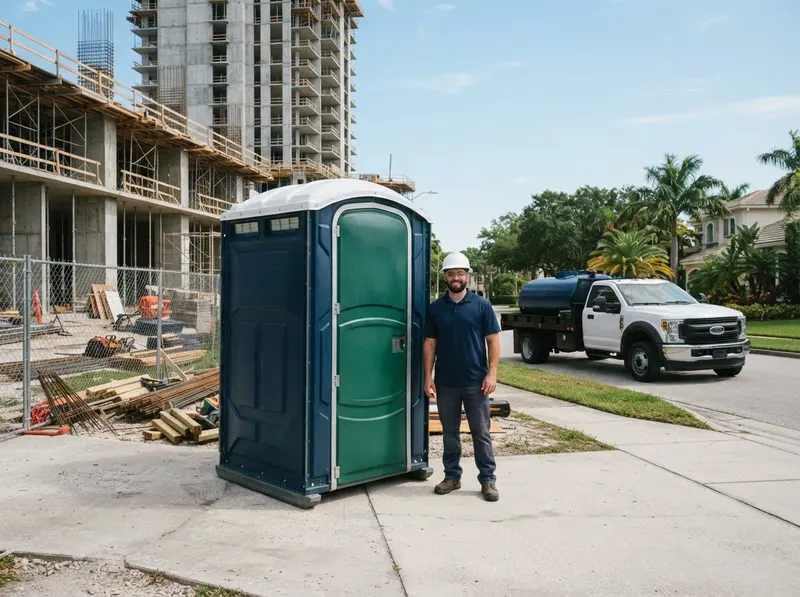
Multi-story vertical construction demands rigorous adherence to sanitation logistics to prevent costly worker transit delays. In the Channel District and downtown corridors near Amalie Arena, moving laborers down twenty flights of external buck hoists for basic biological needs drains measurable productive labor hours. Standard ground-level poly units cannot withstand high-wind shear on open elevated decks or fit into standard vertical hoists. High-rise units solve this by integrating certified heavy-gauge steel roll cages, balanced overhead lift eyes, and 33-inch-wide profiles that roll through standard framed rough-openings and material elevators. For structural pours where crane time is shared with rebar bundles and concrete forms, the engineered hoist points enable direct picks by certified riggers to upper forming decks without hazardous rigging improvisations.
Servicing elevated units on urban towers requires specialized pressure pumping equipment rather than gravity-fed routing. Mobile service crews deploy heavy-duty high-lift vacuum hoses connected to specialized staging pumps to service units placed on upper levels, or superintendents use material hoists to stage units onto loading platforms during scheduled early-morning pump windows. This operational precision avoids full, foul holding tanks on active jobsites, directly eliminating biological hazards in enclosed framing bays. In coastal wind zones near Bayshore Boulevard and Davis Islands, these reinforced units provide low-center-of-gravity stabilization, preventing unit overturns during sudden squalls or high-velocity wind gusts off Hillsborough Bay.
Choosing high-rise units involves a clear operational trade-off: high-rise steel units feature compact 38 to 60-gallon holding reservoirs, requiring more frequent, precise extraction intervals than standard 60 to 70-gallon ground units. For active site supervisors running continuous concrete finishing crews, pairing high-rise roll-around units with established weekly pump cycles maintains mandatory municipal inspection standards without tying up exterior lifts during active shifts. The operational sequence is straightforward: 1. Confirm your tower hoist door clearances and crane rigging schedules. 2. Receive dispatch staging at your designated ground perimeter or laydown pad. 3. Hook tested lifting cables directly to the factory-certified frame eyes for immediate upper-floor placement. 4. Execute non-disruptive pump cycles handled during designated low-traffic work windows.
Every job gets a firm, written price after a free on-site visit.
Tell us about your construction high-rise portable toilets job in Tampa and we'll send a clear, written quote, usually the same day.
 Rocky Mountain Portable Toilets